KNOXVILLE, TN, May 02, 2026 /24-7PressRelease/ — A clearer pulse signal could mean earlier warning before danger strikes. This study introduces an interfacial engineered triboelectric sensor (IETS) designed to capture weak arterial pulse waves even when a wearable device is pressed tightly against the skin. By improving how stress is transferred across the sensor-skin interface, the device preserves fine pulse-wave details that are often lost in conventional wearables. Integrated with machine learning, the system turns those signals into real-time assessments of cardiovascular condition and fatigue state. The work points to a more practical path for wearable warning systems that could help reduce fatigue-related driving risks and support everyday cardiovascular monitoring.
Pulse-wave monitoring has become a promising route for noninvasive health tracking, but it faces a stubborn real-world problem: the pulse is faint, while the pressure from straps, patches, and uneven skin contact can distort the signal. Earlier mechanical and triboelectric sensors improved sensitivity through surface microstructures, yet many still lost performance under preload or failed to capture complete waveform features. Gaps between skin and device also weakened stress transfer, lowering the signal-to-noise ratio. Because of these challenges, there is a need to carry out in-depth research on wearable pulse sensors that remain accurate under preload and imperfect contact conditions.
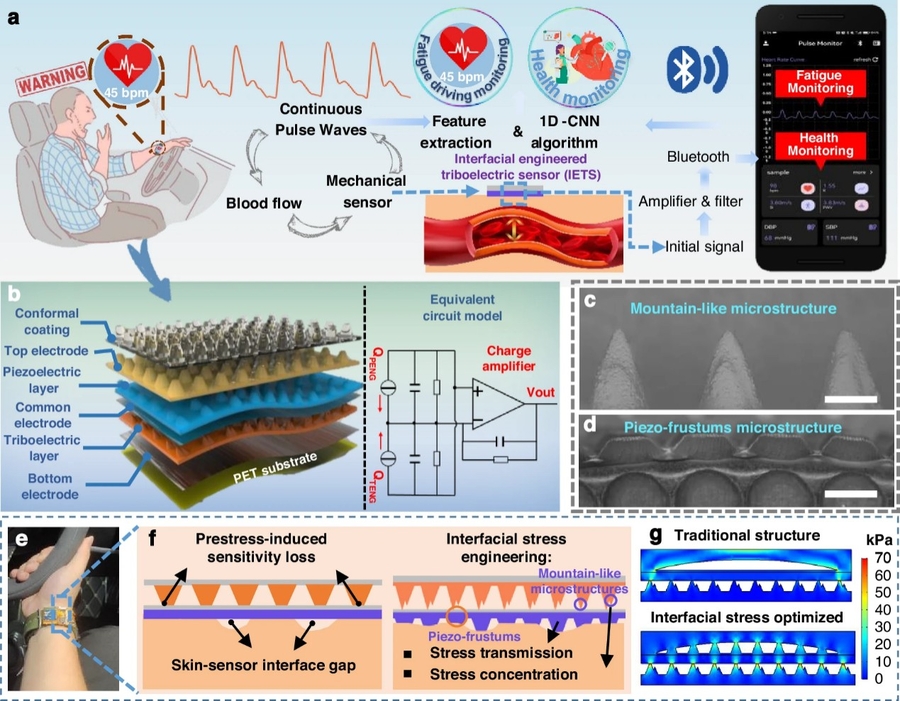
Researchers from Xi’an Jiaotong-Liverpool University, Soochow University, and the University of Liverpool reported (DOI: 10.1038/s41378-025-01107-x) in Microsystems & Nanoengineering in 2026 that they had developed a wrist-worn monitoring system built around the interfacial engineered triboelectric sensor (IETS). The device combines piezo-frustums at the sensor-skin interface with mountain-like microstructures at the triboelectric interface, then links the resulting pulse signal to a Bluetooth-enabled mobile app and machine-learning analysis. The study shows how structural design at the interface level can improve wearable sensing where conventional close-contact assumptions often fail.
The engineering is the story here. Piezo-frustums help fill microscopic gaps between the wrist and the device, creating better stress-transfer pathways while also generating piezoelectric charges. At the same time, mountain-like microstructures create multiple stress-concentration points, helping the triboelectric layer stay responsive under pressure. Together, these features gave the sensor a sensitivity of 4.28 V/kPa, a detection limit of 2 Pa, a response time of 70 ms, and a detection range up to 110 kPa. Under a preload of 10 kPa, the device captured three clear pulse-wave peaks that simpler structures could not resolve. Built into a smart strap, the system then extracted heart rate variability (HRV) features, converted signals for analysis, and used a one-dimensional convolutional neural network (1D-CNN) to classify fatigue-related states with accuracy reaching 98% for one subject.
“This is the kind of wearable that does more than record a signal,” the study suggests. “It keeps working when real life gets in the way—when skin is uneven, straps are tight, and pressure conditions shift. By preserving the fine structure of pulse waves, it moves fatigue and cardiovascular monitoring closer to the moment when an alert can still make a difference.” That conclusion captures the paper’s central message: better interface design can turn a fragile laboratory signal into something robust enough for daily safety use.
The implications reach beyond the driver’s seat. The paper also showed that the same sensing platform could track blinking, yawning, pedal operation, seat occupancy, and seat-belt status, suggesting a broader wearable safety network that combines physiology with behavior. In that sense, the study is not only about one smart wrist sensor. It is about a design strategy for future wearable nanoelectronics: engineer the interface first, and the data become far more useful. For road safety, that could mean earlier warnings. For health monitoring, it could mean more reliable sensing outside the lab, where it matters most.
References
DOI
10.1038/s41378-025-01107-x
Original Source URL
https://doi.org/10.1038/s41378-025-01107-x
Funding information
This work was supported by the National Key R&D Program of China (No. 2023YFB3208100), the National Natural Science Foundation of China (No. 62522407, No. 62174115, No. 62273247), the Natural Science Foundation of the Jiangsu Higher Education Institutions of China Program (No. 19KJB510059), Suzhou Science and Technology Development Planning Project: Key Industrial Technology Innovation (No. SYG202009, No. SYG201924), Jiangsu Key Laboratory for Carbon-based Functional Materials & Devices, Soochow University (No. KJS2157), XJTLU Research Development Fund (No. RDF-17-01-13, No. RDF-21-02-068 and No. RDF-22-01-110) and SIP AI innovation platform (No.YZCXPT2022103).
About Microsystems & Nanoengineering
Microsystems & Nanoengineering is an online-only, open access international journal devoted to publishing original research results and reviews on all aspects of Micro and Nano Electro Mechanical Systems from fundamental to applied research. The journal is published by Springer Nature in partnership with the Aerospace Information Research Institute, Chinese Academy of Sciences, supported by the State Key Laboratory of Transducer Technology.
Chuanlink Innovations, where revolutionary ideas meet their true potential. Our name, rooted in the essence of transmission and connection, reflects our commitment to fostering innovation and facilitating the journey of ideas from inception to realization.
Related Link:
http://chuanlink-innovations.com
—
For the original version of this press release, please visit 24-7PressRelease.com here
Legal Disclaimer: The content on this page is syndicated from independent third-party providers. Kyrion Media makes no warranties or representations regarding the accuracy, completeness, legality, or reliability of the information, including text, images, videos, or licenses. If you are affiliated with this content or have any complaints, copyright concerns, or requests for removal, please contact us at retract@kyrionmedia.com with the specific URL of the content in question. We will review and address valid requests promptly.